Monday, May 13, 2013

The Lost Three-Wheeled Dymaxion

20130104-182716.jpg
 
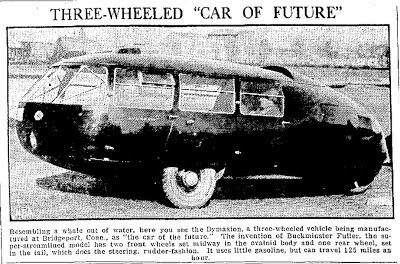
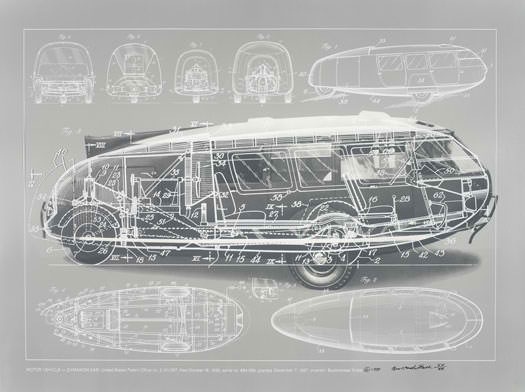
  It was voted one of the 50 worst cars of all time and deemed ‘unworkable’– but I think it looks pretty rad if you ask me, as long as you don’t actually try to drive it or anything. It resembles a torpedo but its fastest documented speed was only 90 miles per hour (although the inventor of course maintained it could reach up to 120 mph). Designed as a prototype in 1933 by American inventor and architect Buckminster Fuller, considered one of the 20th century’s greatest nut jobs, the vehicle’s body was an unusual teardrop shape and measured in at 20 feet long (over 6 metres).

 
20130104-182725.jpg

  But the Dymaxion was damned from the get go when the prototype debuted at the Chicago World’s Fair in 1933 and crashed, killing the driver even though he was wearing a seatbelt, and badly injuring two passengers. The accident saw the vehicle roll over and with only a canvas roof, the prototype offered very little crash protection. Perhaps they would need to rethink a few things before
 
20130104-182732.jpg

20130104-182736.jpg

  The true cause of the accident was never determined, while Fuller reported that the accident was due to the actions of another vehicle that had been following closely, of course. Unsurprisingly, the Dymaxion project was scrapped pretty quickly, although its beautiful design did heavily influence several subsequent automobile designs, including the iconic Fiat 600 Multipla, picture below.
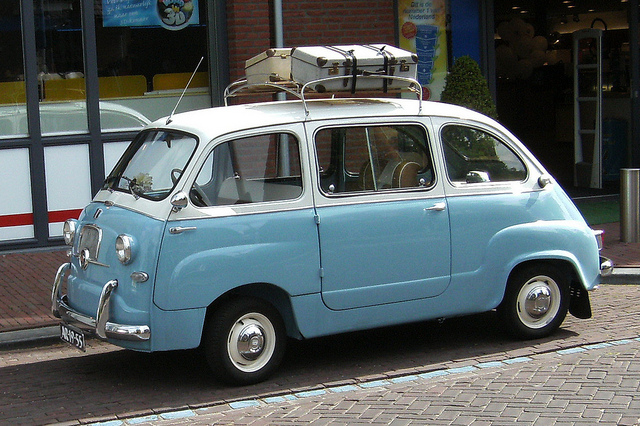
 

Fiat 600 Multipla

20130104-182823.jpg
20130104-182826.jpg

     Of the three original prototype Dymaxions produced, one was badly damaged, another is on display at the National Automobile Museum in Reno, Nevada and the third changed hands so many times it was lost and presumed scrapped by the 1950s. In 2010 architect Sir Norman Foster recreated the car, producing the last Dymaxion in the world.
:::
 

.


Sunday, May 12, 2013

The Car Park Theatre of Detroit

20121229-130010.jpg

  Detroit’s horrible, beautiful decline has been so well documented by urban explorers that to the outside world, it might seem it’s the only thing to know about this once great industrial metropolis. And yet undeniably, it’s vast urban abandonment is intensely interesting. My latest guilty fascination is the Detroit’s renaissance revival theatre that has ended up of all things, as a car park.

20121229-130240.jpg
 
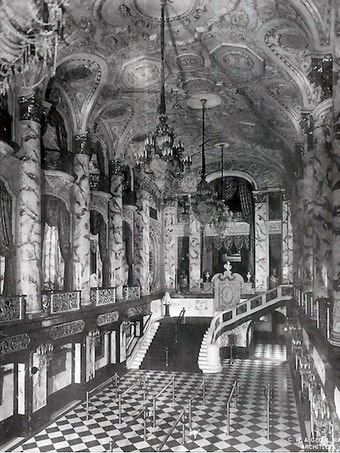
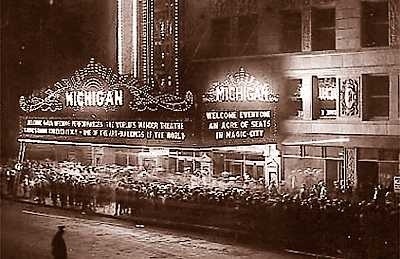
  The Michigan theatre was built in 1926 at a cost of $5 million, close to $60 million today. Designed to leave visitors in awe of its magnificence, the 1,000 square foot showplace boasted more than 4,000 seats, ten foot crystal chandeliers and lavish gilding. Despite its initial black tie dress code, by the 50s and 60s, after changing ownership several times, the theatre began hosting less glamorous events such as screenings of hockey games for those who could not attend the nearby Olympia stadium. By the early 1970s it became a nightclub called the Michigan Palace and a venue for small rock concerts. In 1976, the theatre had its final curtain call and the closed for good.

20121229-130027.jpg
1926 vs Today

  Abandoned with plans for demolition, the theatre was a sad emblem of the end of an era. An adjoining office building next door needed a parking garage for its tenants, but studies quickly determined that demolition of the theatre would be impossible. 

20121229-130237.jpg

  The Michigan was integral to the structure of the office building and destroying the old venue would be a potential disaster. And so the decision was made to gut the auditorium, making enough room for three-level parking garage, leaving the ornate ceilings, the grand lobby, parts of the mezzanine, staircase and balcony foyers in tact (almost). Even the projection booth is still there, covered in dust.
 
20121229-143415.jpg
 
20121229-130031.jpg

  Certainly the car fumes aren’t doing this place any good, but ironically, the building has returned to its first origins. The Michigan theatre had in fact been built right on top of the small garage where Henry Ford built his first ever car. The historical garage was even transported to the Henry Ford museum in Dearborn, Michigan, brick by brick.
 
20121229-130020.jpg
 
  This shocking, magnificent, horrifying, beautiful place lives on, for better or for worse.
Images by Paul Hitz, Bob Jagendorf, Jim Garrett via nogoodnik

.


The Paris Time Capsule Apartment Lock for 70 Years


    A Parisian apartment left untouched for over 70 years was discovered in the quartier of Pigalle a few summers ago and I’ve been meaning to share the pictures with you. Time to unlock the vault …


    The owner of this apartment, Mrs. De Florian left Paris just before the rumblings of World War II broke out in Europe. She closed up her shutters and left for the South of France, never to return to the city again. Seven decades later she passed away at the age of 91. It was only when her heirs enlisted professionals to make an inventory of the Parisian apartment she left behind, that this time capsule was finally unlocked.

20120509-160521.jpg

  The team that had the honor of opening what must have been a very stiff old lock for the first time in 70 years, likened the experience to ‘stumbling into the castle of sleeping beauty’. The smell of dust, the cobwebs, the silence, was overwhelming; a once in a lifetime experience.


   With some expert historical opinion, the ribbon-bound love letters were quickly recognized as the calling card of none other than Giovanni Boldini, one of Paris’ most important painters of the Belle Époque. The painting was his. The beautiful woman pictured in the painting was Mrs. de Florian’s grand-mother, Marthe de Florian, a beautiful French actress and socialite of the Belle Époque. She was Boldini’s muse. And, despite him being a married man, she was also his lover. The art world went a bit nutty for the whole story and the painting was later sold for $3 million at auction.


  What I find so intriguing about this story is not so much the discovered painting and the revelation of a love affair between a great Italian painter and the beautiful actress in an enchanting era, but more the story of Mrs. de Florian and why she stayed away from Paris for so long.
What kept her away even after the war? Was she running away from someone or something other than the Nazis? For all those decades, her rent on the elegant apartment in a flourishing city had been faithfully paid, but it was left to freeze in time. It all sounds like the perfect mystery…